Vera Weber · 23 September 2026
Shifts in Violet Pigment Stability Across Different Humidity Levels in Studio Environments
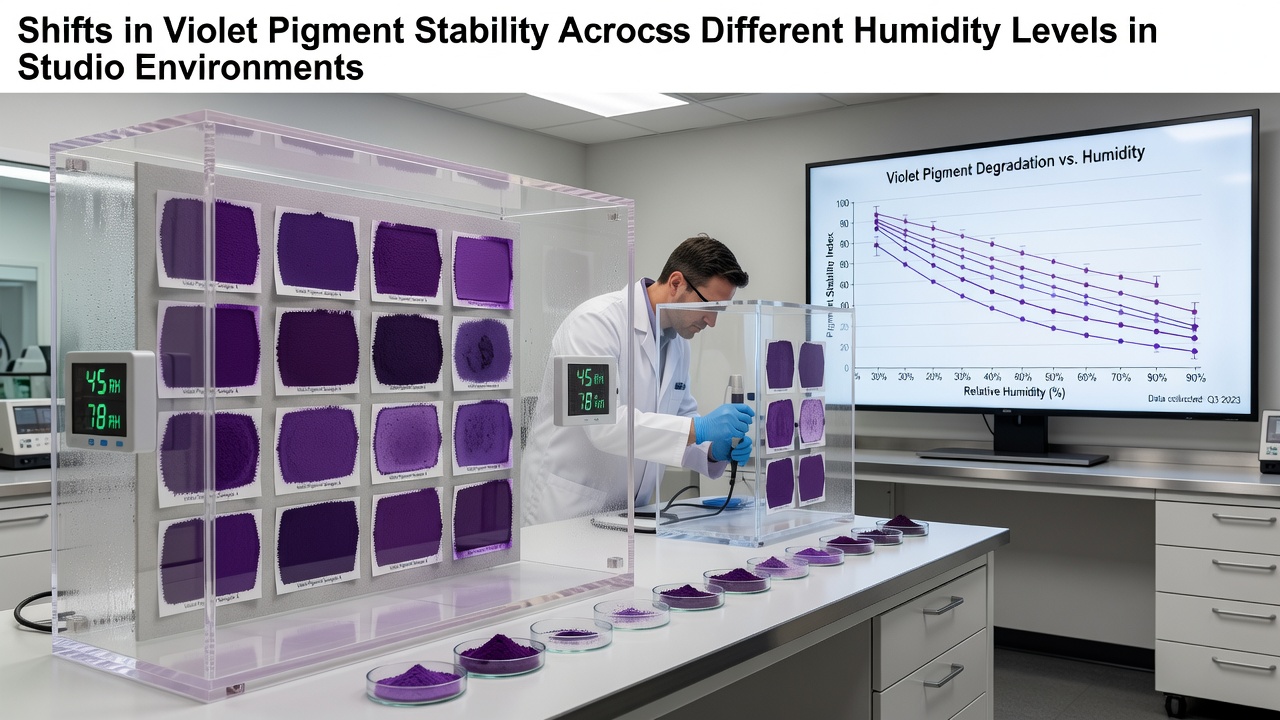
Artists and conservators track how violet pigments respond when studio humidity rises or falls because these colors often contain compounds that interact with moisture in measurable ways, and data collected over multiple seasons shows consistent patterns across different regions. Research from institutions monitoring art materials indicates that relative humidity levels between 30 and 70 percent produce the most noticeable shifts in hue intensity for certain synthetic and mineral-based violets, while levels outside that range accelerate fading or darkening depending on the binder used in the paint film.
Understanding Violet Pigment Composition
Violet pigments range from traditional manganese compounds to modern organic molecules such as dioxazine derivatives, and each type carries distinct chemical structures that determine how water vapor penetrates the paint layer. Studies conducted at university laboratories demonstrate that manganese violet maintains structural integrity longer under fluctuating conditions because its crystalline lattice resists hydrolysis, whereas organic violets absorb ambient moisture more readily and therefore exhibit quicker changes in light absorption spectra. Observers note that artists working in mixed-media studios frequently combine these pigments with acrylic or oil mediums, and the medium itself modulates the rate at which humidity reaches the pigment particles.
Humidity Thresholds and Observed Changes
When studio humidity climbs above 65 percent for extended periods, violet samples begin to show measurable desaturation within weeks, according to controlled exposure trials run by conservation scientists. At the opposite end of the spectrum, environments kept below 35 percent relative humidity cause some violet films to develop micro-cracking that scatters light and reduces apparent saturation even though the pigment chemistry remains unchanged. Data collected from multiple studio monitoring projects reveals a non-linear response curve where the steepest color shifts occur between 45 and 55 percent humidity, a range many artists maintain for comfort yet which coincides with peak pigment vulnerability.
Studio Environment Variables
Air circulation patterns, temperature cycling, and light exposure combine with humidity to influence outcomes, and researchers have documented faster degradation when ultraviolet sources remain active during high-humidity episodes. In one documented case, a university-affiliated studio in Canada recorded violet swatches losing 12 percent chroma after 90 days at 72 percent humidity with daily temperature swings of 8 degrees Celsius, while identical samples held at constant 45 percent humidity retained nearly full saturation. European heritage laboratories report similar trends, noting that ventilation systems designed for human comfort sometimes create localized humidity pockets near storage racks where finished works rest.
September 2026 brings renewed attention to these interactions because several international conservation conferences scheduled for that month will present updated datasets gathered from artist studios across North America and the Asia-Pacific region. Preliminary abstracts released by organizing bodies suggest that new sensor networks installed in working studios now capture real-time humidity gradients at the scale of individual canvases, allowing finer calibration of environmental recommendations than earlier bulk-room measurements permitted.
Measurement Techniques and Data Collection
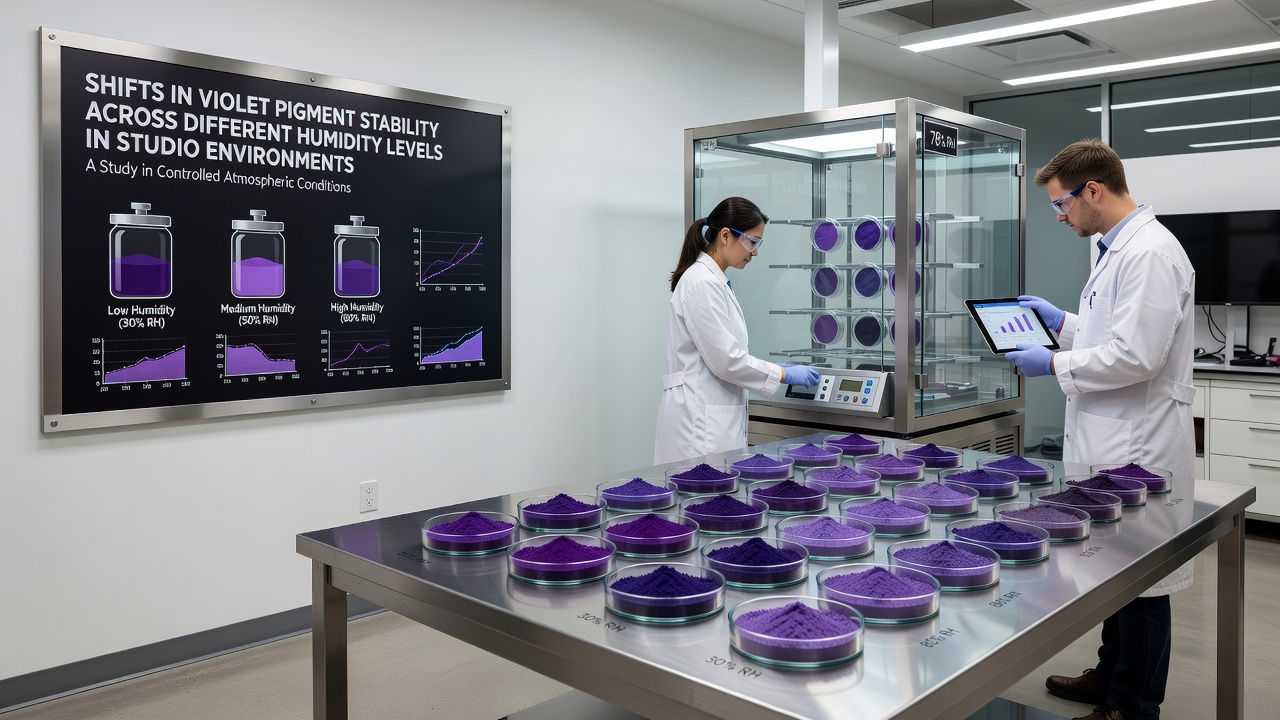
Spectrophotometers and colorimeters provide quantitative records of pigment drift, and conservators increasingly pair these instruments with dataloggers that record humidity every fifteen minutes. Figures from ongoing projects indicate that organic violet pigments shift toward blue undertones when moisture content in the paint film exceeds 4 percent by weight, while inorganic violets tend toward gray-brown shifts under the same conditions. Those who maintain long-term archives compare readings taken at 20 percent, 40 percent, 60 percent, and 80 percent relative humidity to establish baseline stability profiles for each pigment batch before artists incorporate them into larger works.
Practical Implications for Artists and Conservators
Artists who store works in progress inside humidity-controlled cabinets report fewer unexpected color changes between painting sessions, and institutions such as the Getty Conservation Institute have published guidelines that translate laboratory findings into studio practice. Meanwhile, regulatory frameworks from Australian heritage agencies emphasize monitoring rather than rigid humidity targets because local climate conditions vary widely and artists adapt workspaces accordingly. The ball remains in the court of individual practitioners to balance comfort, equipment costs, and pigment longevity when setting daily targets.
Conclusion
Collective evidence from laboratory trials and field monitoring establishes that violet pigment stability varies systematically with humidity, and the magnitude of change depends on pigment chemistry, binder type, and concurrent environmental factors. Continued data collection through 2026 and beyond will refine the thresholds at which protective measures become necessary, giving studios clearer parameters for preserving intended color relationships over time.